Bifocal vs Progressive Lenses: Types, Benefits and Design Differences

Two pairs of glasses are not your only option when you need help with both distance and reading. But choosing a lens without a visible line does not tell you how it works. This guide compares lined bifocals, invisible bifocals and progressive lenses, then explains the design choices that change your everyday experience.
What does “multifocal” mean?
Multifocal is a broad term for lenses with more than one focal power. Bifocal, trifocal and progressive spectacle lenses belong to this family. In everyday conversation, “multifocal” is sometimes used specifically for progressives, but the terms are not identical. This article concerns eyeglass lenses, not multifocal contact lenses or lenses implanted during surgery.
Near-focus difficulty associated with aging is called presbyopia. Your prescription and an assessment of your visual needs determine the appropriate correction; age alone is not a lens-selection rule.
[5] [6]1. Lined bifocal lenses
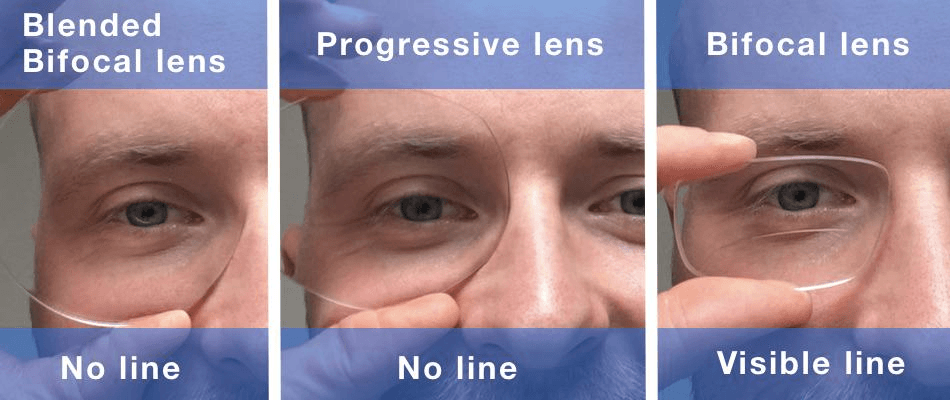
A lined bifocal contains a distance area and a separate near segment, often D-shaped or round. The dividing boundary is visible; it does not necessarily run across the entire middle of the lens.
Benefits
- Two clearly defined viewing areas for distance and reading.
- A familiar arrangement for people who already use bifocals successfully.
- A straightforward option when a dedicated intermediate zone is not a priority.
Limitations
- The visible segment may be cosmetically undesirable.
- Crossing the segment boundary can produce an apparent movement of the image, known as image jump; its degree depends on the design.
- There is no dedicated intermediate-power zone. A computer screen may fall between the two corrected distances.
Worth discussing if: you are happy with your current bifocals and mainly switch between distance and a consistent reading task.
[2] [5]2. Invisible or blended bifocal lenses
Invisible bifocals keep two main viewing powers but blend the boundary of the near segment so it is less noticeable. “Invisible,” “blended” and “seamless” describe a family of designs, not one uniform product.
Benefits
- A more discreet appearance than a conventional visible segment.
- Distance and reading correction without a conventional progressive corridor.
- Some digital designs aim to reduce image jump and improve the transition.
Limitations
- The blending area can introduce localized blur or distortion.
- Hiding the line does not create a dedicated computer-vision zone.
- Segment visibility, reading area and transition behavior vary by product.
Ask for the exact manufacturer and design. Traditional blended bifocals and newer digital versions should not be assumed to behave identically. The invisible-bifocal concept has existed for decades, even though individual designs continue to develop.
[1] [3] [4]3. Progressive lenses
Progressive lenses, also called varifocals, change power gradually from distance through intermediate to near. There is no visible segment line.
Benefits
- One pair can cover a range of everyday viewing distances.
- Intermediate power is available for tasks between distance and reading.
- A line-free appearance with continuous power change.
Limitations
- Usable viewing areas are not equally wide everywhere.
- Side blur and a sense of movement can occur as you look through different areas.
- Frame fit, measurements and learning how to use the lens matter.
Worth discussing if: your day involves changing frequently between people across a room, a screen and reading. For the introductory explanation, read our progressive lens guide.
[6] [8]Lined bifocal vs invisible bifocal vs progressive
| Feature | Lined bifocal | Invisible bifocal | Progressive |
|---|---|---|---|
| Appearance | Visible near segment | Boundary concealed or less noticeable | No segment line |
| Main powers | Distance and near | Distance and near | Gradual range from distance to near |
| Dedicated intermediate zone | No | Generally no | Yes; usable width varies |
| Transition | Distinct power change | Product-dependent blend | Progressive corridor |
| Main trade-off | Visible boundary and possible image jump | Blend-area distortion and limited intermediate support | Peripheral blur and narrower task zones |
This table describes the general designs, not a guaranteed result for every product or prescription. [1–3, 5–6, 8]
What is the progressive corridor?
The corridor is the central transition path where lens power increases toward the near area. It includes powers used for intermediate distances. It is not the same thing as the blurred areas on either side.
Manufacturers can define corridor specifications using different reference points. A stated corridor length is also not interchangeable with the minimum fitting height needed to fit the lens into a frame.
Short versus longer corridors
A shorter corridor reaches the near power over less vertical space. This can help accommodate shallower frames, but compressing the power change introduces optical trade-offs. A longer transition spreads the change over more space and requires an appropriate frame and gaze position. Compare designs at the same addition power rather than assuming “short” or “long” is inherently better.
[7] [10] [12]Why are the sides of a progressive lens blurred?
Gradually changing power across a lens creates unwanted astigmatism in areas beside the corridor. This is a property of progressive optics, not automatically a manufacturing defect. These are areas of reduced clarity, not opaque or completely sightless areas.
Designers manage where this blur sits and how rapidly it increases. Addition power, corridor geometry and the overall design influence the result. Premium design can manage these compromises; it does not abolish them.
In practice, you may need to turn your head toward an object rather than look far sideways through the lens. However, progressives do not force the eyes to move only up and down.
[7] [8]Hard, soft, hybrid and personalized designs
These terms describe optical design choices. They do not describe whether the lens material is physically hard or soft.
Hard design
Tends to concentrate unwanted astigmatism into more restricted regions, preserving broad clear areas elsewhere. The transition into side blur can feel more abrupt.
Soft design
Spreads the change in blur more gradually across a larger area. This can feel smoother, with a different balance of clear-zone widths.
Hybrid design
Combines features of both approaches. The useful balance depends on the specific design and wearer, rather than the label alone.
Freeform is a manufacturing method; personalization is a design choice
Digital freeform surfacing allows complex lens surfaces to be produced precisely. A lens described as “digital” is not necessarily fully individualized. Ask which personal measurements and viewing needs are actually used to calculate it.
Depending on the product, personalization may use prescription, frame geometry, lens-to-eye distance, frame tilt, wrap angle and working distance. A reading-focused design and a balanced everyday design can share the same prescription while allocating useful vision differently.
[9] [10]Are progressive lenses always best for computer work?
Not necessarily. General-purpose progressives serve several distances, while an occupational or office lens prioritizes near and intermediate work. That can provide more useful space for a screen and desk tasks.
For example, a person spending most of the day at two monitors may value a dedicated office pair more than a larger reading zone in an all-day progressive. Office designs have a specified maximum clear distance and should not be used for driving when they do not provide the required distance correction.
[11] [12]How to choose at Eagle Optics
Bring your current glasses and prescription, and describe the tasks that matter most. Useful questions include:
- What distance do I use for my phone, book and monitor?
- Do I need one everyday pair, a dedicated work pair, or both?
- Which exact design is being supplied, and why does it suit my frame?
- What fitting measurements does this design require?
- What follow-up is available if vision is uncomfortable?
Fitting starts with an adjusted, stable frame. For progressive lenses, distance PD and fitting height are measured for each eye according to the manufacturer’s guide. Additional position-of-wear measurements depend on the chosen design. [13] The prescription, selected design, frame position and fitting measurements need to work together. Lens index and coatings are separate choices: an anti-reflective coating does not replace the correct corridor or fitting.
Find a lens design that fits your day
Contact Eagle Optics in Sohag to discuss your prescription, daily tasks and frame choice.
Discuss your glasses on WhatsAppFrequently asked questions
Are all no-line lenses progressive?
No. Invisible bifocals can also have no obvious line. Ask whether the lens has two main powers or a progressive intermediate corridor.
Which lens has the widest reading area?
There is no universal winner. Compare the actual near segment or clear zone for the same prescription, addition and fitting conditions.
Will a premium progressive remove all side blur?
No. It may improve how blur is distributed and how the lens suits you, but progressive optics still involve trade-offs.
How long does adaptation take?
It varies; some people feel comfortable quickly, while others need days or weeks. Persistent discomfort or difficulty using the intended zones warrants a fitting and prescription review rather than simply waiting.
Does a wider frame automatically give a wider corridor?
No. Frame size and usable intermediate width are different. The optical design and fitting determine how you access the useful areas.
Sources and further reading
- OptoTech — Invisible Bifocal
- DAI Optical — BIFORM free-form bifocals
- ILT — Blended bifocal lenses
- Younger Optics — Specialty & multifocal lenses
- ZEISS — The right lenses for optimum vision
- ZEISS — SmartLife progressive lenses
- ZEISS — History of progressive lenses and corridor trade-offs
- ZEISS — Light 2: hard, soft and hybrid designs
- ZEISS — Individualized lenses with freeform technology
- ZEISS — Choosing progressive lenses
- HOYA — Occupational lenses
- ZEISS — Office lens white paper
- ZEISS — Progressive Individual 2 fitting and dispensing guide